
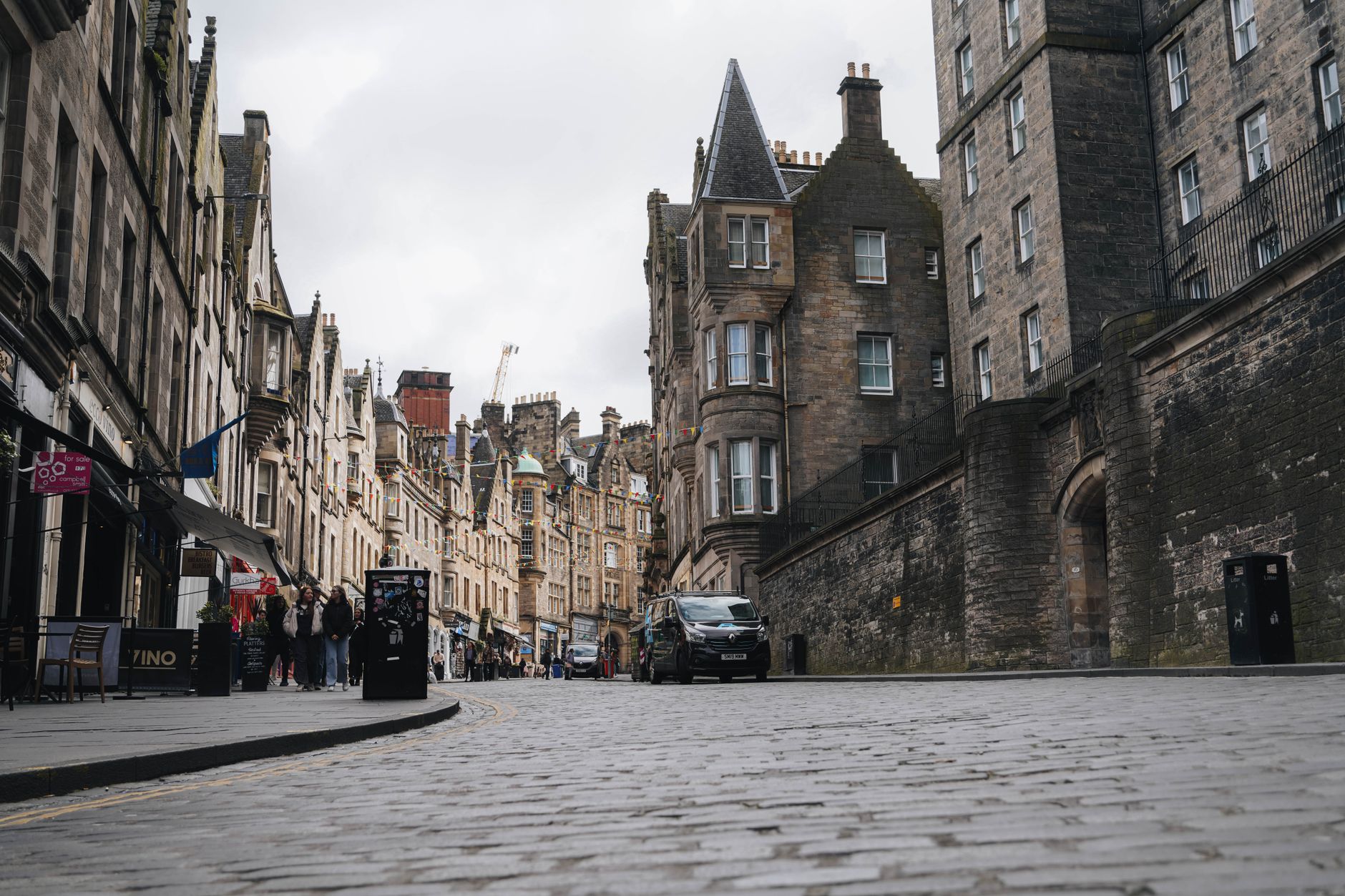
Edinburgh’s Old Town is famous for its closes – narrow passageways that wind through the city’s medieval heart, though not all of these historic streets survived. Dozens of closes have vanished entirely, buried beneath newer buildings, deliberately erased to make way for Victorian improvements, or lost to tragedy and collapse. Understanding which closes disappeared and why reveals a hidden layer of Edinburgh’s urban evolution, telling a story of plague, poverty, industrial ambition, and the sometimes brutal decisions that shaped the city we see today.
The loss of Edinburgh’s closes was not a gradual fading away. It was orchestrated – by city planners, by architects, and by the economics of 19th-century urban renewal. Some closes were simply demolished to make room for wider streets and modern infrastructure. Others were buried alive beneath massive civic structures. A few were repurposed beyond recognition, their original character erased in service of utilitarian functions. And some were consumed by catastrophic structural failures that claimed lives and sealed their fate.
Today, only fragments remain – a sealed entrance, a street name, an underground vault – to hint at the closes that once buzzed with life and history.
The Closes That Were Swallowed Whole
Mary King’s Close and the Royal Exchange
Mary King’s Close is perhaps the most famous vanished close, though its story is one of burial rather than destruction. In the 18th century, Edinburgh’s city authorities made an ambitious decision: to build a grand new Royal Exchange in the heart of the Old Town. The site they chose, opposite St Giles’ Cathedral, was already occupied by existing closes – Mary King’s Close, Stewart’s Close, Pearson’s Close, and Allan’s Close among them.
Rather than demolish these buildings entirely, the city adopted a pragmatic approach. Workers removed the upper storeys of the closes and repurposed the lower levels and basement structures as the foundation for the new Royal Exchange building. Mary King’s Close and its neighbours were effectively entombed beneath a massive neoclassical structure, their street-level presence erased but their physical remains preserved in darkness below.
This happened in 1753. For over 250 years, Mary King’s Close remained sealed and forgotten, hidden from the world until modern-day tours began revealing its secrets to visitors. The close was further disrupted when the far-north end was demolished in 1853 during the construction of Cockburn Street.
Fleshmarket Close: Partially Demolished and Buried
Like Mary King’s Close, Fleshmarket Close – named after the meat market and slaughterhouse that once operated there – fell victim to 18th-century city development. The close was hit particularly hard during the 17th-century bubonic plague. Later, it too was partially demolished and buried due to the construction of the Royal Exchange in 1753. What remains today is only the portion that survives above ground, accessible to visitors but forever diminished from its original extent.
Streets Erased for Victorian Progress: Cockburn Street and Beyond
The Demolition of Entire Close Networks
The most dramatic erasure of Edinburgh’s closes came in the mid-to-late 19th century, during the Victorian era of urban improvement. In 1854, Edinburgh’s authorities approved an ambitious plan to demolish many of the oldest and most deteriorated closes and build a new, improved roadway linking High Street to Market Street. This roadway became Cockburn Street.
The construction of Cockburn Street (1856–1859) was transformative but devastating. Entire arrays of medieval and Renaissance houses were levelled to the ground. The street cut through the delicate, winding web of the Old Town’s original wynds and closes, severing connections that had existed for centuries. This was not accidental damage – it was deliberate urban surgery, driven by a desire to modernise Edinburgh and provide better access to the newly opened Waverley Station (1846).
Alongside Cockburn Street, Jeffrey Street was constructed with similar disregard for the existing close network, further fragmenting the medieval street pattern and erasing passageways that had stood for hundreds of years.
Closes Repurposed: From Residences to Storage Yards
Covenant Close and Trunk Close
Not every lost close was physically demolished. Some underwent a more subtle erasure – they were emptied of human inhabitants and repurposed entirely. Covenant Close and Trunk Close experienced this fate. These spaces, which had once witnessed the signing of historic documents and housed the nation’s greatest legal minds, were cleared of all residents and transformed into storage yards for the heavy iron implements used by the city’s street-scavenging crews.
In this way, the closes lost their identity as living communities. They became purely utilitarian, stripped of the social fabric that had defined them for centuries. The buildings remained, but the close itself – as a neighbourhood, a workplace, a gathering place – simply ceased to exist.
Tragedy and Collapse: Paisley Close in 1861
The Night the Tenement Fell
Some closes disappeared not by decision but by disaster. Paisley Close, located just off the High Street, was home to a towering seven-storey tenement in the mid-19th century. On 24 November 1861, shortly after midnight, the building collapsed catastrophically. A baker, attempting to enlarge his oven, had unknowingly broken through a load-bearing wall, destabilising the entire structure.
Of the 77 people living in that tenement, 35 were either killed immediately in the rubble or died later from their injuries. The collapse was one of Edinburgh’s worst domestic disasters, and it marked a turning point in how the city treated its overcrowded Old Town slums.
Above the entrance to Paisley Close today stands a carved stone lintel bearing the face of a young boy and the words: “Heave awa’ chaps, I’m no deid yet!” This refers to Joseph McIvor, a 12-year-old resident who was pulled alive from the rubble after rescuers heard him shouting. The lintel serves as both memorial and warning – a reminder of the human cost of poverty and poor housing conditions in Victorian Edinburgh.
Why Closes Disappeared: The Perfect Storm of Urban Change
From Wealthy Enclaves to Overcrowded Slums
To understand why so many closes were demolished or abandoned, it’s essential to understand how dramatically Edinburgh changed between the 18th and 19th centuries. In the 18th century, Edinburgh’s closes were the address of choice for the city’s elite. Judges, wealthy merchants, and the Scottish nobility lived in the middle floors of tall tenements known as “lands,” while servants and tradespeople occupied the lower storeys and basements. It was a vertical microcosm of society, all united by shared turnpike stairs winding through the darkness.
This golden age did not last. When Edinburgh’s New Town was designed and built (beginning in 1767), wealthy residents fled the cramped, medieval Old Town for spacious, orderly Georgian streets and squares. The closes they abandoned were immediately reoccupied by the poor and working classes. Buildings that had once housed nobility became tenement slums, subdivided into smaller and smaller units.
By the 19th century, the closes had transformed entirely. Living conditions were appalling. Sanitation was non-existent, disease ran rampant, and population density was crushing. The closes became repositories of poverty, crime, and suffering. For respectable Victorian society, they represented everything modern progress should eliminate.
The Edinburgh Improvement Act of 1867
This cultural shift led to systematic destruction. Demolitions in the Cowgate and throughout the Old Town were largely triggered by the Edinburgh Improvement Act of 1867, a radical attempt to sweep away the squalor and misery of the closes and overcrowded tenements. The Act gave the city legal authority to demolish large areas and rebuild them according to new standards of hygiene, safety, and aesthetic propriety.
Similar clearance programmes continued into the 1920s, removing most of the surviving buildings on the west side of closes like Advocates Close. This was not urban renewal driven by nostalgia or heritage preservation – it was driven by public health concerns, moral disapproval of poverty, and a desire to remake the city in the image of Victorian respectability.
Patrick Geddes and “Conservative Surgery”
Not all 19th-century intervention in the Old Town was purely destructive. The philanthropist and town planner Patrick Geddes pioneered an alternative approach he called “conservative surgery.” Rather than demolish entire closes and rebuild from scratch, Geddes aimed to preserve the most historically significant parts of Old Town buildings by removing only the most dilapidated sections, thereby making what remained more hygienic and suitable for living without erasing the buildings’ character.
Geddes applied this principle to Riddle’s Close on the Lawnmarket, converting parts of it into one of Edinburgh’s first student halls of residence. His approach was gentler than wholesale demolition, but it still involved selective erasure and alteration of the closes’ original form.
What Happened to the Sites of Lost Closes
| Lost Close or Area | What Replaced It | Date of Demolition / Change | Status Today |
|---|---|---|---|
| Mary King’s Close | Royal Exchange (now City Chambers) | 1753; further demolished 1853 | Underground vaults accessible to visitors |
| Fleshmarket Close | Partially buried beneath Royal Exchange | 1753 | Partial above-ground remnant survives |
| Network of closes | Cockburn Street | 1856–1859 | Victorian street; truncated close remnants remain |
| Covenant Close & Trunk Close | Repurposed as storage yards | 19th century | Mostly demolished; fragments may remain |
| Paisley Close tenement | Rebuilding after 1861 collapse | 1861 (collapse) | Close survives but entirely rebuilt; lintel memorial remains |
| Corn Exchange area | O2 Academy Edinburgh (modern entertainment venue) | 1850s demolition; 1910 new building | Modern entertainment venue on site |
Buried and Underground: The Closes Beneath Your Feet
Some closes did not disappear entirely – they went underground. The most famous example is Mary King’s Close, but it is not the only one. When the Royal Exchange was built, at least four closes were buried beneath it. When Cockburn Street was cut through the Old Town, the slopes and gradients required that some areas be built upon, effectively entombing sections of the medieval close network.
Below Edinburgh’s Old Town runs an extensive network of vaults, subterranean passages, and sealed closes. Some were discovered and explored during the 1980s. Others have only recently been rediscovered during modern building works. The Lost Close, located beneath a former courthouse off Parliament Square, was rediscovered in 2019. It contains layers of archaeological evidence from the Great Fire of Edinburgh (1824) and earlier periods.
These underground spaces are among the most haunting remnants of lost Edinburgh. They preserve, in fossilised form, the streets and structures that once bustled with life above.
Which Closes Still Survive?
It is easy to focus on what was lost and forget what remains. Edinburgh still has over 250 closes, with most located in the Old Town running along both sides of the Royal Mile. Many of these survivors are genuinely ancient, retaining buildings and street patterns dating back to the 16th and 17th centuries.
Advocates Close, despite 1920s slum clearance that removed its west side buildings, still retains 16th-century structures on its east side. Warriston Close and Lady Stair’s Close survived, though both narrowly escaped demolition in the late 19th century. Riddle’s Close was carefully preserved through Patrick Geddes’ interventionist approach. White Horse Close, though heavily rebuilt in the 1960s, still marks the location of one of the Old Town’s famous coaching inns.
These surviving closes are not pristine medieval streets. Most have been substantially altered, rebuilt, and modified. But they retain enough of their original character – their narrowness, their steep slopes, their enclosure – to give visitors a genuine sense of how Edinburgh’s Old Town once felt to those who lived and worked there.
Why Lost Closes Matter to Modern Edinburgh
The disappearance of Edinburgh’s closes is not merely a historical curiosity. It reflects fundamental questions about how cities change, who benefits from urban development, and what gets preserved versus what gets erased. In Victorian Edinburgh, the answer was clear: medieval slums were demolished to make room for modern progress, and the poor residents displaced by that progress left few records of their lives.
Yet the closes also embody resilience. Those that survive today have been carefully studied and, in recent decades, restored. Edinburgh World Heritage’s Twelve Closes project, launched in 2015, has worked to enhance and improve twelve of the city’s historic pedestrian streets. Visitors increasingly value the atmosphere and character of the surviving closes, understanding them as authentic windows into medieval and early modern urban life.
The lost closes remind us that Edinburgh’s appearance today is the result of choices – some deliberate, some accidental, all consequential. To walk the surviving closes is to see both what remains and what is gone, to understand a city not as a static heritage site but as a living organism that has continually shed its skin and grown anew.
Exploring Edinburgh’s Surviving Close Network
If you want to experience Edinburgh’s closes and understand the scale of what has been lost, begin with a walk along the Royal Mile. You’ll see the truncated ends of Cockburn Street, where traces of older closes peek through. Step into surviving closes like Advocates, Warriston, and Lady Stair’s to feel the narrowness and enclosure that once defined the entire Old Town network.
Visit The Real Mary King’s Close to descend into the buried passages beneath the city. Book a tour of The Lost Close at Parliament Square to see how 19th-century civic ambition sealed away centuries of history. Walk past the lintel stone at Paisley Close, marked with the face of Joseph McIvor, and consider what that symbol represents – not just a single tragedy, but the thousands of lives lived and lost in the closes that are now gone.
The surviving closes, modest as they sometimes seem, are remarkable precisely because they endured. They are reminders that Edinburgh’s urban identity was shaped not only by what was preserved but by what was deliberately, systematically erased.
Frequently Asked Questions
How many Edinburgh closes have been completely lost?
It is difficult to establish an exact number, but historical records suggest that dozens of closes have been significantly altered, demolished, or buried. Edinburgh once had around 250 separately named closes along the Royal Mile. Many of these have been erased or radically transformed by 19th-century improvements, particularly the construction of Cockburn Street and Jeffrey Street. Of those that remain, most have been substantially rebuilt or altered.
Can you still visit any of the underground lost closes?
Yes. Mary King’s Close is accessible as a visitor attraction beneath the Royal Mile. The Lost Close at Parliament Square is also open to visitors for guided tours, tastings, and historical experiences. Some sections of other buried closes are occasionally revealed during archaeological work, but public access is limited. Most underground closes remain sealed and inaccessible.
Why were so many closes demolished in Victorian times?
The closes were demolished primarily due to severe overcrowding, appalling sanitation, disease, and poverty. By the 19th century, the medieval closes had become densely packed slums. The Edinburgh Improvement Act of 1867 gave authorities the power to demolish large areas in the name of public health and urban progress. This reflected both genuine concerns about disease and hygiene, and Victorian attitudes that equated medieval architecture with moral failure.
Is Paisley Close still accessible today?
Yes, Paisley Close still exists and is accessible to visitors. The current close is not the original medieval close but a rebuilt version created after the catastrophic tenement collapse of 1861. The memorial lintel bearing the face of Joseph McIvor and the words “Heave awa’ chaps, I’m no deid yet!” remains above the entrance and is one of the Old Town’s most poignant historical markers.
What was the “conservative surgery” approach to the closes?
“Conservative surgery” was an approach pioneered by Patrick Geddes, a philanthropist and town planner active in Edinburgh in the 1880s and 1890s. Rather than demolish entire buildings, Geddes aimed to preserve historically significant parts of Old Town structures while removing only the most dilapidated sections, making the buildings more hygienic and safe. This approach was gentler than wholesale demolition but still involved selective alteration of the closes’ character.
Where can I learn more about Edinburgh’s lost closes?
The National Library of Scotland, National Records of Scotland, and trove.scot (Historic Environment Scotland’s digital archive) contain extensive historical records, maps, and photographs documenting Edinburgh’s closes across centuries. Archaeological reports from excavations in the Old Town, particularly around Advocates Close and the Cowgate, provide detailed evidence of demolished structures. Local history societies and the City of Edinburgh Council’s archives also hold valuable resources.
The Enduring Legacy of Edinburgh’s Lost Closes
The story of Edinburgh’s lost closes is ultimately a story about urban change, about choices made and consequences incurred. Every vanished close represents not just a street but a community, a network of lives and livelihoods that shaped the city’s character. The demolitions of the 19th century were driven by genuine problems – overcrowding, disease, poverty – but they also erased a world that many Victorians found inconvenient to acknowledge.
Today, what remains of Edinburgh’s close network is itself under threat from neglect and disrepair. Modern initiatives like the Twelve Closes project recognise that these surviving medieval passageways are irreplaceable. They are fragments of an older, denser, more vertically complex Edinburgh – one that was sometimes squalid and unsafe but also vibrant, interconnected, and socially layered in ways that modern urban planning has made impossible to replicate.
To walk a surviving close is to walk through history but also through loss. The narrowness, the shadows, the sense of enclosure – these are the only ways we can now experience what the city felt like before progress erased so much of it. The lost closes are gone, but their absence shapes how we understand the Edinburgh that remains.