
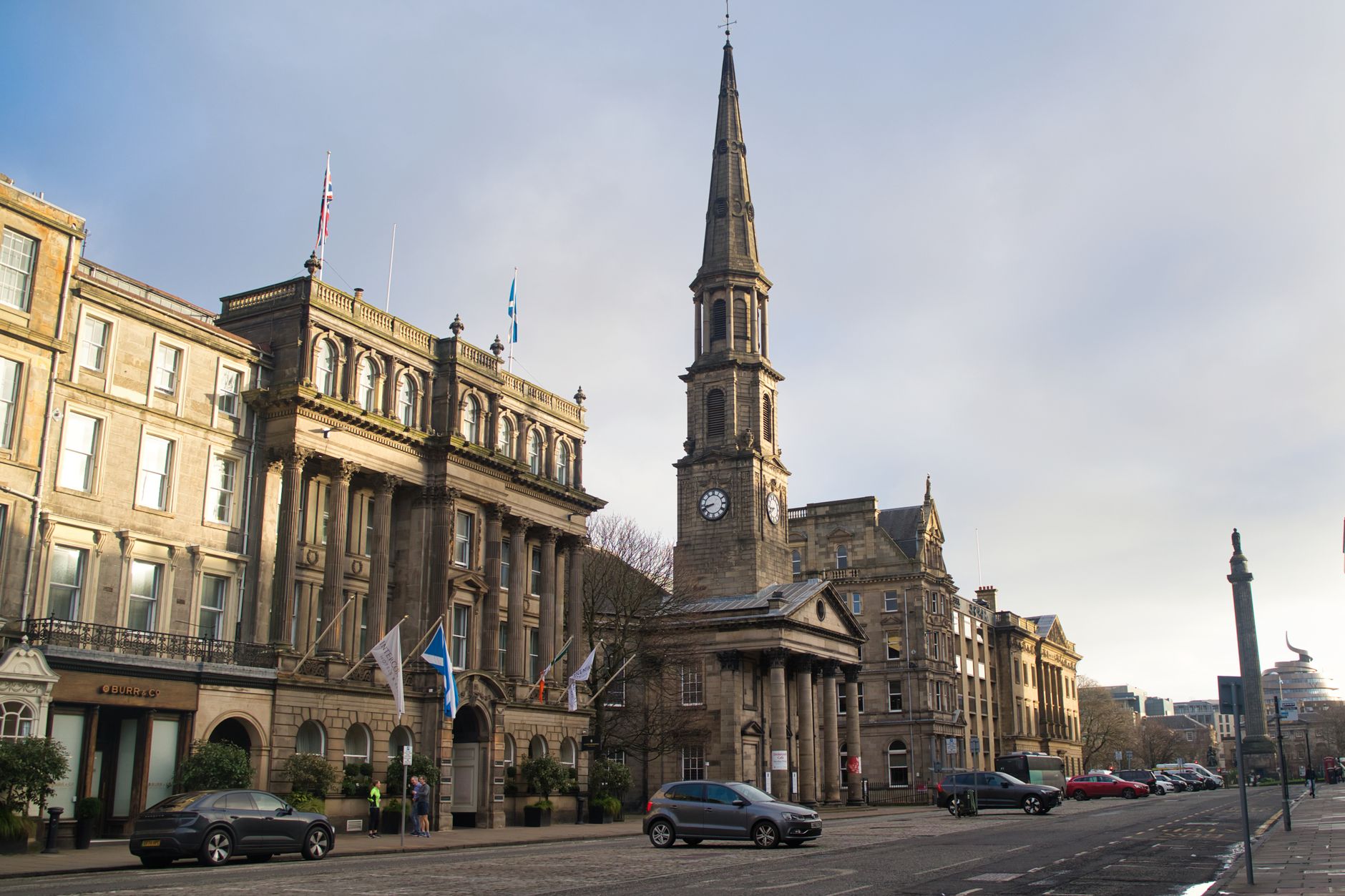
George Street stands as one of Edinburgh’s most recognisable thoroughfares, a wide and elegant avenue that forms the heart of the city’s Georgian New Town. Today, visitors wandering its length encounter a blend of grand neoclassical architecture and modern retail vibrancy – boutiques, restaurants, bars and cultural venues set against facades designed more than two centuries ago. Yet for most of those two centuries, George Street was something quite different, a transformation that tells much about how Edinburgh’s city centre has evolved.
To understand George Street as it exists today, it’s essential to know where it came from. The street’s origins lie in a radical reimagining of Edinburgh itself during the 1760s, when the medieval Old Town had become desperately overcrowded. A young architect named James Craig won a competition to design a new district to the north – one that would be spacious, orderly, and distinctly modern. George Street emerged as the grand central spine of that first phase of development, deliberately planned to be the most prominent street of all.
Visiting today, you’ll see a street that has transformed multiple times within its Georgian shell. The architecture remains largely faithful to its origins, yet the purposes it serves have shifted dramatically. Understanding this history helps explain why George Street today looks the way it does and why it remains such a compelling destination for both visitors and locals seeking something more refined than the bustle of Princes Street.
The Birth of a Grand Design: Georgian Origins
In 1766, architect James Craig’s vision for the New Town took shape as a competition-winning design. The plan was deliberately egalitarian in its ambition: to move Edinburgh’s wealthy residents away from the tenements and squalor of the Old Town and into a spacious, orderly new district. Craig’s design formed a grid-like pattern of three principal streets running east to west, anchored at each end by large squares with private gardens for residents.
George Street itself was named after King George III, reflecting its pre-eminent position as the main thoroughfare. The naming was part of a wider political gesture during the planning phase – surrounding streets were named to emphasise the union between Scotland and England. Queen Street commemorated Queen Charlotte, George III’s wife, while Princes Street honoured the king’s sons. Hanover Street recognised the royal House of Hanover. Together, these names signalled that Edinburgh was presenting itself as a confident, modern capital loyal to the British crown.
The street was laid out to run between two significant public spaces: St Andrew Square to the east and Charlotte Square to the west. Smaller streets – Hanover Street, Frederick Street and Castle Street – bisected it at regular intervals, running north to south. This rational, proportioned geometry stood in sharp contrast to the chaotic medieval lanes of the Old Town just to the south.
Georgian Elegance: What the Architecture Reveals
The buildings that line George Street today retain much of their original character, making the street a living example of 18th-century neoclassical design. The north side exemplifies Georgian architectural uniformity with ashlar sandstone façades, rusticated ground floors and decorative elements including pediments, pilasters and balustrades that emphasise symmetry and classical proportions. Keen-eyed visitors may notice blind windows incorporated into some facades – these are evidence of the 18th and 19th-century window tax, a government levy on windows that made it economical for builders to brick up some openings rather than pay the duty.
By the 19th century, the street’s appearance began to change significantly. Many of the original townhouses were gradually replaced by more imposing Victorian buildings, many designed by the prominent architect David Bryce, who actually lived on the street. These structures blended neoclassical and Victorian elements, establishing a commercial grandeur that still defines the street today. The buildings are predominantly Category A listed by Historic Environment Scotland, reflecting their exceptional historical and architectural significance.
Several buildings deserve particular attention when walking the length of George Street. The Assembly Rooms, opened in 1787, were designed by architect John Henderson and became the social heart of Georgian Edinburgh, hosting grand balls, concerts, dances and civic gatherings where society’s elite came to see and be seen. The magnificent ballroom, chandeliers and classical interiors remain among the most impressive public rooms in Scotland. Today, the Assembly Rooms continue to host concerts, festivals, exhibitions and events, playing an important role during the Edinburgh Festival season.
The Victorian Transformation: From Homes to Commerce
The Georgian New Town was conceived entirely as a residential district for the wealthy. George Street, as first built in the late 1760s, consisted of elegant townhouses where Edinburgh’s elite families lived. This period lasted surprisingly short: by the Victorian era, the character of the street had changed fundamentally.
As Edinburgh’s commercial life expanded and businesses sought prestigious addresses, the grand homes began to be replaced by shops, showrooms, banks, small department stores and hotels. This transformation was not accidental – when the New Town was initially laid out, George Street, not Princes Street, had actually been earmarked as the main commercial strip. However, George Street lacked the spectacular views of the castle and gardens that made Princes Street irresistible to retailers. Instead, it became the city’s financial district, lined with banks and insurance offices rather than consumer shops.
This hybrid character – Georgian architecture serving Victorian commercial purposes – persisted throughout the 20th century and into the early 21st. For much of the modern era, George Street remained distinctly upmarket but somewhat more austere than its neighbouring shopping streets, dominated by financial institutions and formal commercial enterprises.
George Street Today: Shopping, Dining and Culture
The street has undergone a significant shift in the past two decades. As banks and financial firms have consolidated and relocated, their place has increasingly been taken by retailers, restaurants and bars. George Street has evolved to match the commercial intentions of its original planners far more closely than it did for most of the Victorian and 20th-century period.
Shopping and Retail
Today, George Street functions as a major shopping destination, running parallel to and complementing Princes Street as one of Edinburgh’s principal retail streets. The character of the shopping differs from Princes Street: where Princes Street emphasises high street chains and mainstream retail, George Street positions itself as more upmarket and curated.
The street is home to a mix of designer fashion boutiques and established high-street brands. These include:
- Fashion retailers such as Whistles, Anthropologie, All Saints, Mint Velvet, GANT, Joules, White Stuff and Jack Wills
- Designer and menswear specialists including Cruise, Hawes & Curtis and Ede & Ravenscroft
- Jewellery and luxury goods including Hamilton & Inches (established 1866), Laings and ROX Diamond & Thrills
- Beauty and fragrance retailers such as Penhaligons and Molton Brown London
- Homeware and gift retailers including Anthropologie’s complementary offerings of décor and accessories
Many of these retailers occupy buildings that once housed banks, their grand interiors adapted to retail use whilst preserving the exterior architectural integrity. At the eastern end of George Street, the shopping experience extends into Multrees Walk and St Andrew Square, where luxury brands including Louis Vuitton and Gucci offer additional upmarket choice.
Dining, Bars and Entertainment
George Street has become renowned as Edinburgh’s primary destination for dining and nightlife. The street hosts a diverse range of restaurants, from casual cafés to fine dining establishments. Alongside dining venues, the street features cocktail bars and clubs, creating an atmosphere that transforms across the day and into evening.
Notably, a central section of George Street operates as a car-free zone during much of the year, designated to allow al fresco dining in summer months and to support the pedestrian experience. This makes the street particularly pleasant for those who wish to linger over a meal or drink whilst observing the architectural grandeur surrounding them. During the summer festival season and at Christmas, the street hosts pop-up venues, temporary bars and market structures that add further variety to its commercial character.
Cultural Landmarks
Beyond retail and hospitality, George Street remains home to significant cultural institutions. The Assembly Rooms continue to function as a major event and festival venue. St Andrew’s Church, the Church of Scotland parish church on George Street, remains architecturally notable – founded in 1781 and opened in 1784, it features an elliptical plan that was the first of its kind in Britain. The interior incorporates ceiling design in the style of Robert Adam with many features found in Roman and Pompeian design.
Other notable buildings along the street include the Freemasons Hall at 96 George Street, the worldwide headquarters of the Grand Lodge of Scotland, and The Dome, a striking Greco-Roman structure built in the 1840s as the Commercial Bank of Scotland. Several buildings now operate as hotels, including the InterContinental Edinburgh The George.
Distinctive Features and What to Notice When Walking the Street
George Street’s character is defined by several elements that reward closer attention. The wide, straight thoroughfare itself is uncommon in Edinburgh and reflects the New Town’s principle of rational urban planning. This width gives the street an open, dignified quality quite different from the narrow close and lanes of the Old Town.
Statuary punctuates the street at regular intervals. Three significant monuments mark junctions across the street’s length:
- A statue honouring James Clerk Maxwell, the Scottish physicist (1831–1879) whose work on electromagnetism fundamentally advanced physics
- A monument to William Pitt the Younger, Prime Minister and a figure of immense political importance in late 18th-century Britain, who served under George III
- A statue of Dr Thomas Chalmers, a 19th-century churchman, theologian and social reformer who is regarded as one of Scotland’s greatest religious figures
A statue of King George IV, depicted in Highland dress, overlooks Hanover Street as it descends northwards. This distinctive costume choice reflected the romantic vision of Scotland that Sir Walter Scott had popularised and helped stage-manage during the king’s visit to Edinburgh in 1822.
The street is bookended by two significant squares. To the east, St Andrew Square, once surrounded by elegant residences, is now a busy commercial centre with gardens and restaurant spaces. To the west, Charlotte Square is regarded by many historians as the masterpiece of the New Town. Its elegant terraces were designed by Robert Adam to provide a grand conclusion to the New Town’s original development.
Future Development: The George Street and First New Town Transformation
George Street is at the centre of an ambitious public realm project that aims to reshape how the street functions and feels. The George Street and First New Town (GSNT) transformation project represents one of the most significant investments in the area’s public spaces in recent decades.
The project has evolved through extensive consultation with residents, businesses and stakeholders over several years. Design work progressed through multiple phases, with concept design principles approved in 2021. The final developed design was completed and progressed through Royal Institute of British Architects (RIBA) Stage 3 in late 2022.
Core elements of the proposed design include:
- Significantly widened pavements to improve pedestrian space and comfort
- Introduction of a Dutch-style cycling street through the central spine of the street
- Removal of parking bays (whilst retaining blue badge disabled access and essential resident parking)
- Extensive greening plans including planting and landscaping with rain gardens to improve climate resilience
- Use of natural stone appropriate to the street’s World Heritage Site status
- Creation of landscape seating areas to provide places for people to pause and rest
The project prioritises pedestrians and sustainable travel, reducing non-essential vehicle access. This builds on earlier proposals developed from 2016 onwards, refining the vision for a more people-focused street environment that celebrates the architectural heritage whilst meeting 21st-century needs for sustainable transport and public space quality.
Following approval of recommendations and completion of statutory process requirements through RIBA Stage 4, the Council has been working to secure final approvals and funding arrangements for the project. As of 2025, the project remained in its final planning and approval phase, with construction expected to commence subject to securing all necessary consents and funding confirmation.
Visitor Information and Getting the Most from George Street
George Street is centrally located within the New Town and is easily accessed from most parts of Edinburgh’s city centre. It runs parallel to Princes Street just a short walk to the north, making it simple to visit both streets as part of a city centre visit.
The half-mile length of the street can be comfortably walked in 20 to 30 minutes at a leisurely pace without stopping, but most visitors will want to spend considerably longer exploring shops, pausing in cafés or restaurants, and observing the architectural details. A particularly rewarding approach is to start at either Charlotte Square or St Andrew Square and work along the length, allowing the street’s proportions and individual buildings to reveal themselves gradually.
The best viewpoint for photographing Edinburgh Castle through the street is often cited as the junction with Princes Street and Frederick Street, where the castle frames attractively at the street’s southern vista. The street is partly pedestrianised, making it safe and pleasant for visitors on foot. During summer and the festival season, the atmosphere is particularly animated, with restaurants and bars extending onto the pavements and temporary venues adding novelty.
For those interested in architecture and history, the street rewards closer inspection of individual buildings. Tourist guides and the local George Street Association provide additional detail about significant buildings and their histories. Information panels installed along the street help explain the area’s development and heritage.
Understanding George Street’s Place in Edinburgh
George Street’s journey from fashionable residential avenue to Victorian financial district to modern mixed-use destination reflects broader shifts in how city centres function. Its survival as a functioning, thriving street – rather than a preserved museum piece – is testament to its adaptability and to the continued quality of its architecture and location.
What makes George Street distinctive compared to other Edinburgh shopping streets is this layering of history and use. The grandeur of its architecture gives shopping and dining an elevated quality. The street’s width and proportions create a sense of dignity and openness. Its carefully curated retail mix reflects a commitment to quality over volume. And its role as a cultural venue and social gathering place – not merely a commercial strip – maintains the public-spirited character that James Craig originally envisioned when designing the New Town.
For many visitors, George Street captures something essential about Edinburgh: a city that honours its past while embracing present vitality, where history is not confined to museums but remains part of everyday urban life. Whether you come to shop, dine, explore cultural venues or simply admire the architecture, George Street offers a very complete Edinburgh experience compressed into a single elegant avenue.
Frequently Asked Questions About George Street
Is George Street pedestrianised?
George Street is partially pedestrianised. A central section operates as a car-free zone to allow al fresco dining and to improve the pedestrian environment, particularly during summer months and the festival season. The street remains accessible to vehicles at certain times, though traffic is limited. The George Street and First New Town transformation project aims to further reduce vehicular traffic and expand the pedestrian-friendly areas once construction commences.
What is the difference between shopping on George Street and Princes Street?
Princes Street emphasises high street chains and mainstream brands, whereas George Street positions itself as more upmarket and curated, with a greater concentration of designer boutiques, independent retailers and luxury brands. George Street also functions more strongly as a dining and entertainment destination, whereas Princes Street remains primarily retail-focused. Additionally, George Street has preserved more of its architectural character, with its Georgian facades less obscured by modern shopfront design.
Why are there blind windows in the buildings on George Street?
Many buildings on George Street feature bricked-up windows that appear as decorative blind window frames. These are evidence of the 18th and 19th-century window tax, a government levy imposed based on the number of windows in a property. Builders and property owners sometimes found it economical to brick up certain windows rather than pay ongoing tax on them. The frames were often retained for aesthetic symmetry and proportion, even after the tax was eventually abolished.
When was George Street built?
George Street was established in the late 18th century as part of James Craig’s New Town plan. The street and its original Georgian townhouses were developed from the 1770s onwards. Many Victorian buildings were added during the 19th century, particularly from the 1840s onwards when the street’s commercial function expanded. The street therefore represents a blend of late 18th-century Georgian design and 19th-century Victorian commercial architecture.
What is the nearest landmark to George Street for orientation?
George Street runs between two prominent squares. St Andrew Square marks the eastern end and Charlotte Square the western end. Both contain gardens and significant buildings, making them useful orientation points. The street also intersects with Princes Street, which is Edinburgh’s most famous shopping street and a clear landmark for city navigation.
Is George Street suitable for visitors with mobility difficulties?
The street’s width and relatively gentle gradient make it accessible compared to many Edinburgh streets. However, as with much of central Edinburgh, uneven historic paving and cobbles present some challenges. The George Street and First New Town transformation project includes specific provisions to improve accessibility, including widened pavements and better surface conditions. Individual retail and hospitality venues vary in their accessibility provisions – it is advisable to check specific venue information before visiting.